

Analyzing Cost Drivers in Custom Silk Sleepwear: Momme Weight, Dyeing Methods, and Fabric Yield


Establishing a profitable supply chain for luxury sleepwear requires a precise command over unit economics. Unlike synthetic apparel categories where garment assembly labor constitutes the primary manufacturing expense, custom silk sleepwear pricing is heavily weighted toward raw material consumption and highly specialized wet processing. Silk is traded globally as a commodity by weight, meaning every square centimeter of fabric waste directly degrades profit margins. A minor miscalculation in fabric yield, an over-specified momme weight, or an inefficient printing specification can render an entire production run commercially unviable before the fabric ever reaches the cutting table. This technical analysis deconstructs the primary financial drivers in silk sleepwear manufacturing, providing B2B procurement teams with the empirical data necessary to optimize their wholesale silk pajamas cost without sacrificing the structural integrity or visual grade of the final product.
1. The Financial Impact of Momme Weight Specifications
Momme (mm) functions as the standard unit of density for silk fabrics, denoting the weight in pounds of a piece of fabric measuring 45 inches by 100 yards. In metric terms, one momme equals approximately 4.3056 grams per square meter (gsm). Because the raw silk yarn is the most expensive input in the supply chain, the cost of the finished fabric scales linearly with its momme weight. The decision between different density grades fundamentally dictates the baseline cost of the garment.
For commercial sleepwear, 16 momme (roughly 69 gsm) serves as the entry-level baseline. It provides adequate opacity in dark colors and a light, breathable drape. However, upgrading a program from 16 momme to 19 momme (82 gsm) increases raw material consumption by exactly 18.75%. Upgrading further to 22 momme (95 gsm) increases silk consumption by 37.5% compared to the 16 momme baseline. Procurement directors must align the momme specification strictly with their retail price architecture. The 19 momme standard dominates the premium retail sector because it provides the structural stability required for daily friction and regular laundering while avoiding the heavier, restrictive drape of 22 momme suit-weight fabrics. For a detailed breakdown, refer to our silk momme weight guide.
Furthermore, heavier momme weights incur secondary logistical costs. A shipment of 5,000 pajama sets cut from 22 momme silk will weigh significantly more than the same volume cut from 16 momme silk, escalating volumetric weight charges in global air freight. Precise density specification is the first step in stabilizing supply chain costs.
2. Dyeing and Printing Technologies: Fixed Setup vs. Variable Unit Costs
The application of color and pattern introduces a complex matrix of fixed and variable costs. Solid color piece-dyeing remains the most economically efficient processing method. Commercial dye houses utilize low-tension jet dyeing machines that saturate the fabric uniformly. Piece dyeing carries relatively low minimum order quantities (MOQs), typically starting around 200 to 300 meters per colorway, with minimal setup fees, keeping the unit cost highly predictable.
Printed sleepwear requires a strict breakeven analysis between rotary screen printing and digital reactive printing. Rotary screen printing requires the physical engraving of cylindrical nickel screens for each individual color present in the design. This creates a high fixed setup cost—often hundreds of dollars per color. For a short production run, amortizing these screen charges across a small number of garments causes the unit cost to skyrocket. However, for high-volume orders exceeding 1,000 meters per colorway, screen printing becomes highly efficient, dropping the variable cost per meter far below digital methods while delivering superior dye penetration to the reverse side of the fabric.
Digital reactive printing eliminates physical screens entirely. The artwork transfers directly from CAD software to the fabric via industrial inkjet heads. This method carries zero setup fees and permits unlimited colors within a single design, making it the superior choice for complex artwork and low-volume production (300 to 500 meters). The trade-off is a higher variable cost per meter due to the slow processing speeds and the high cost of reactive digital inks. Procurement teams must calculate the exact crossover point where order volume justifies the transition from digital to screen printing. For a deeper technical breakdown of print economics, review our silk printing methods guide.
3. Fabric Yield Optimization and Cutting Room Efficiency
Fabric yield—the precise linear length of material required to construct one complete garment—is the most critical variable under the direct control of the apparel brand. A standard two-piece adult pajama set (long sleeves and long trousers) consumes substantial yardage, typically ranging from 2.4 to 2.8 meters depending on the size grade.
Yield optimization occurs during marker making, the CAD process of nesting pattern pieces onto the digital representation of the fabric width. Silk is predominantly woven in standard widths of 114 cm (45 inches) and 140 cm (55 inches). Attempting to nest large trouser panels on a narrow 114 cm width frequently forces inefficient layouts, leaving large gaps of unusable fabric between the pattern pieces. This waste is known as fallout. Transitioning the raw material order to a 140 cm fabric width allows the CAD software to interlock pieces much more efficiently, drastically reducing the fallout percentage. A lay plan efficiency improvement of just 5% can eliminate thousands of dollars in wasted silk across a bulk order, directly suppressing the wholesale silk pajamas cost.
Additionally, the surface design dictates nesting rules. Solid colors and random, non-directional prints allow the cutting room to rotate pattern pieces 180 degrees to maximize interlocking. Conversely, one-way directional prints force the factory to cut every piece facing the same direction, reducing marker efficiency. Geometric patterns, plaids, and engineered border prints require manual pattern matching across the center front placket and chest pockets. This strict alignment forces the cutting room to space pieces further apart to match the print repeat exactly, increasing fabric consumption by 10 to 20 percent per unit.
4. CMT (Cut, Make, Trim) Variables and Construction Standards
The CMT cost isolates the labor, machinery, and finishing components of garment manufacturing. Silk sleepwear demands highly specialized sewing protocols that increase operator handling time. Silk's frictionless surface makes the layers prone to shifting under the sewing machine presser foot. Factories must deploy walking-foot machines and utilize highly skilled sewing operators to prevent mismatched seams and puckering.
The specific construction standards outlined in the tech pack dictate the labor tier. Standard overlocked interior seams are rapid to execute but leave exposed thread edges that fray under tension over time. Premium sleepwear mandates French seams, a finishing technique that completely encloses the raw fabric edges within the seam itself. Constructing a French seam requires the operator to sew, press, fold, and sew every seam a second time. This effectively doubles the assembly time for the garment chassis, raising the CMT price accordingly.
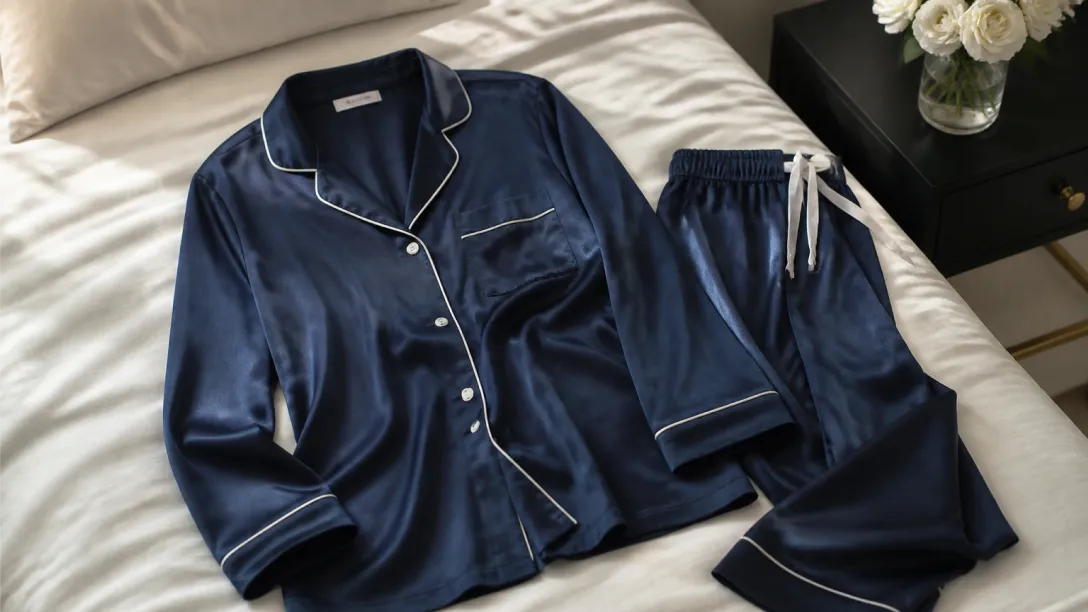
Detailing also consumes intensive labor. Applying contrast silk piping along the lapel, cuffs, and trouser hems requires specialized folding attachments and extreme precision to navigate curves without distorting the main fabric. Furthermore, high stitch density (14 to 16 stitches per inch) consumes more thread and slows down the sewing line, but it prevents the seam slippage that commonly destroys silk garments under stress. Sourcing teams must explicitly define these parameters; requesting a quote for a generic "silk pajama" without specifying French seams and stitch density will result in pricing based on low-tier, overlocked construction.
5. Consolidation Strategy and Supply Chain Economics
Production scale governs the amortization of fixed overhead. The development of tech packs, size grading, pattern making, lab dips, and physical prototyping represent fixed financial outlays. When a brand orders 100 units, these development costs heavily inflate the per-unit price. When distributed across an order of 2,000 units, the impact of development overhead becomes statistically negligible.
Brands optimize their procurement pricing by consolidating fabric usage across multiple SKUs. Using the exact same 19 momme piece-dyed silk base for a long pajama set, a matching short-set, a robe, and sleep accessories allows the buyer to aggregate their fabric order. Pushing the total yardage into a higher volume tier secures lower per-meter fabric costs from the weaving mill and minimizes setup surcharges at the dye house, lowering the aggregate wholesale cost of the entire collection simultaneously.
6. Formulating a Predictable Procurement Model
Controlling custom silk sleepwear pricing requires dissecting the manufacturer's quotation into its fundamental engineering components: raw material consumption, wet processing methodology, and assembly labor. Buyers who understand the mathematical relationship between fabric width and marker efficiency, or the labor impact of French seams versus standard overlocking, can engineer their products to hit precise target margins without compromising end-user durability. To understand the complete silk manufacturing process, buyers should evaluate each step critically. For brands ready to scale their collections with predictable economics, our custom silk pajamas manufacturing infrastructure provides transparent cost breakdowns, optimized marker planning, and certified raw material sourcing to safeguard supply chain profitability.
FAQ
The primary cost driver in wholesale silk sleepwear is the raw material consumption. Silk is a globally traded commodity priced by weight. Therefore, the chosen momme weight combined with the fabric yield (the exact meters of silk required to cut the garment) accounts for the vast majority of the unit cost, far outweighing CMT (labor) expenses.