


Lead Time Management for Holiday Seasons: Sea Freight vs. Air Freight for High-Volume Silk Textiles


Securing production capacity and managing logistics for high-volume silk textile orders prior to the Q4 holiday season is a high-stakes supply chain operation. The financial margin of luxury silk products relies heavily on on-time delivery; missing the Black Friday to Christmas retail window renders seasonal inventory functionally obsolete. B2B procurement directors must execute precise critical path methodology, balancing the exorbitant costs of air freight against the protracted transit times and environmental risks associated with sea freight. This analysis dissects the specific logistical dynamics of shipping bulk silk textiles, providing a framework for optimizing freight modalities and protecting product integrity during transit.
1. The Economics of Volumetric Weight in Silk Freight
Freight forwarders calculate shipping costs based on the higher value between the actual gross weight of the cargo and its volumetric (dimensional) weight. Silk presents a unique logistical challenge because it is a low-density, high-value commodity. A standard carton of custom silk pajamas will almost always price out on volumetric weight rather than actual weight. Conversely, dense, tightly rolled fabrics might price on actual weight.
When comparing air freight to sea freight, this volumetric penalty is highly asymmetric. Air freight applies a steep dimensional divisor (typically dividing cubic centimeters by 6,000 to determine chargeable kilograms). Sea freight, whether LCL (Less than Container Load) or FCL (Full Container Load), charges primarily by cubic meter (CBM) with a much higher density allowance. Consequently, the cost multiplier for shipping bulk silk via air versus sea is rarely 2x or 3x; during the Q4 peak season, air freight for boxed silk garments can cost 8 to 12 times more than sea freight per unit.
Procurement teams must analyze the momme weight of their products to forecast shipping costs accurately. A 22 momme custom silk bedding set possesses significantly more mass and consumes less relative volume than a lightly packed 12 momme garment. For a deeper understanding of how fabric density affects mass, refer to our silk momme weight guide. Optimizing carton dimensions to eliminate dead space is the single most effective method to reduce air freight penalties.
2. Sea Freight: Managing Transit Times and Hygroscopic Risks
Sea freight is the mandatory modality for preserving wholesale margins on high-volume orders. However, relying on ocean transit for Q4 inventory requires factoring in a 35 to 50-day door-to-door transit time, necessitating bulk order confirmation by mid-July at the latest. Beyond timeline management, sea freight exposes silk to severe environmental threats that air freight generally avoids.
The Threat of Moisture and Container Rain
Silk is a highly hygroscopic protein fiber, meaning it readily absorbs moisture from the surrounding atmosphere. During a 40-day ocean voyage, cargo containers experience drastic temperature fluctuations, especially when crossing from tropical manufacturing zones into the colder climates of North American or European destination ports. These temperature drops cause condensation to form on the interior roof of the container, a phenomenon known as "container rain."
If this moisture penetrates the shipping cartons, silk textiles will rapidly develop mildew, irreversible water staining, and a musty odor that ruins the commercial value of the cargo. To mitigate this risk, B2B buyers must mandate strict packing protocols in their purchase orders. Every carton of custom silk clothing shipped by sea must utilize a continuous interior polybag liner. Furthermore, industrial-grade silica gel desiccants must be placed inside the individual garment bags, inside the master carton, and suspended within the shipping container itself.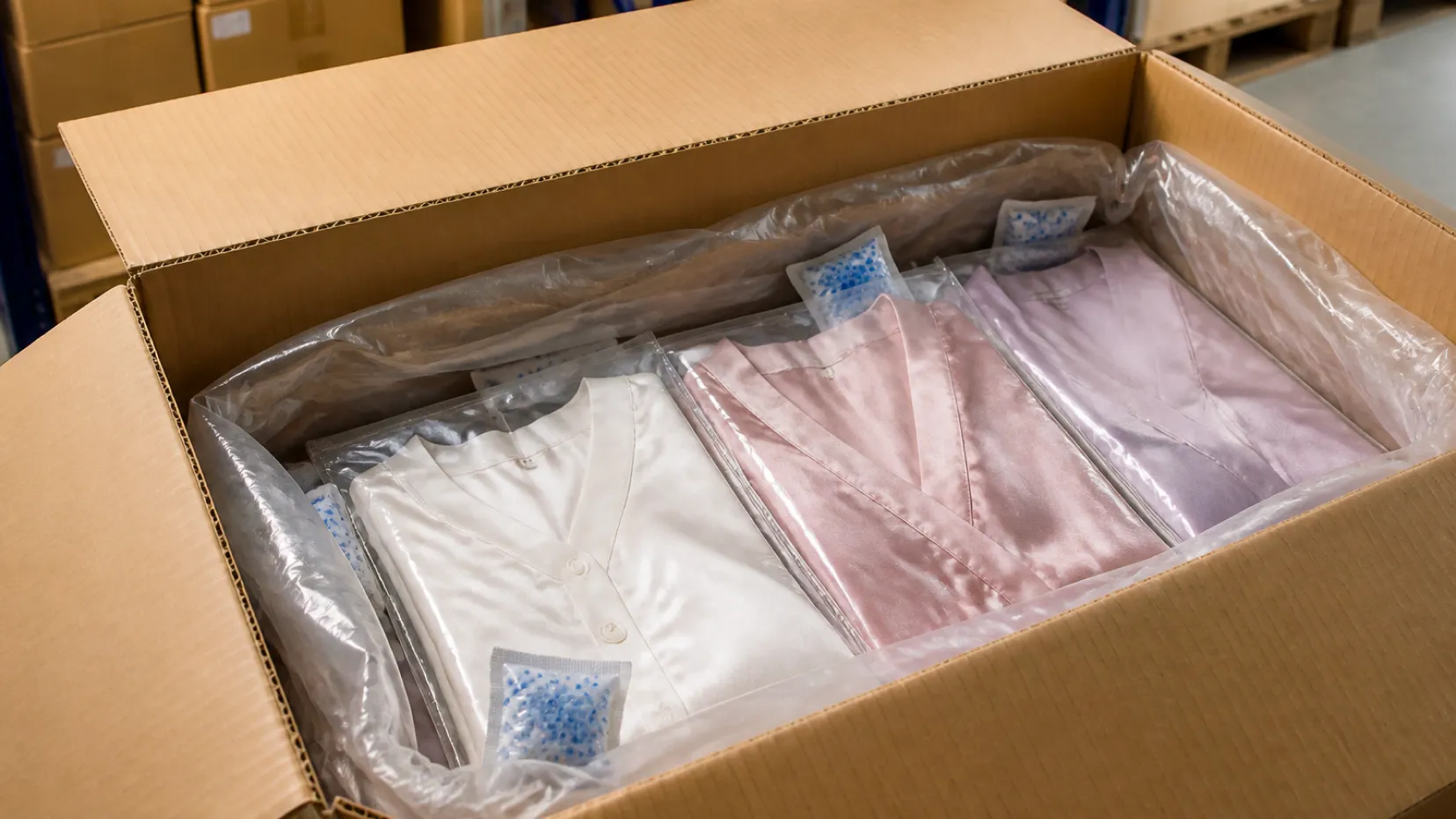
Carton Integrity and Crush Resistance
Sea freight cartons endure high compressive loads while stacked in the lower tiers of a container and subjected to maritime vessel pitching. Standard single-wall cardboard will collapse under this stress. When cartons collapse, the garments inside suffer severe, permanent creasing. Silk is highly susceptible to pressure marks that cannot be entirely removed by retail steaming. Purchase orders must specify double-wall or triple-wall corrugated export cartons with a minimum burst strength rating to guarantee dimensional stability during ocean transit.
3. Air Freight: The Emergency Modality and Peak Season Surcharges
Air freight reduces door-to-door transit time to 5 to 10 days, offering an emergency valve for delayed production runs or unexpected spikes in retail demand. However, relying on air freight during the Q4 peak season (October through November) exposes buyers to extreme price volatility. As global technology releases and fast-fashion volumes monopolize cargo capacity out of Asian hubs, airlines impose peak season surcharges (PSS) that change weekly.
When executing an air freight strategy for items like silk scarves or sleepwear, buyers should instruct the factory to utilize vacuum packing where appropriate. Vacuum sealing extracts the air from the polybags, drastically reducing the cubic volume of the carton. While this technique requires the receiving distribution center to allocate labor for intensive steaming upon arrival, the savings in volumetric air freight charges often outweigh the domestic labor costs. Note that vacuum packing should never be used on structured garments or silk velvet, as it will crush the pile permanently.
4. The Split-Shipment Strategy: Balancing Risk and Margin
The most sophisticated B2B procurement teams do not treat sea and air freight as a binary choice. Instead, they execute a split-shipment strategy to protect both retail availability and overall profit margins. In this model, an order of 10,000 units is divided at the factory level.
Approximately 20% to 30% of the bulk order is dispatched via air freight immediately upon completion. This guarantees that the brand's retail stores and e-commerce fulfillment centers have sufficient inventory to launch the holiday campaign on time and capture early-season sales. The remaining 70% to 80% of the order is loaded into sea containers. By the time the initial air-freighted stock begins to deplete, the ocean freight arrives to replenish the warehouse just before the Black Friday peak. This methodology blends the logistical costs, ensuring product availability while keeping the aggregate freight expense per unit commercially viable.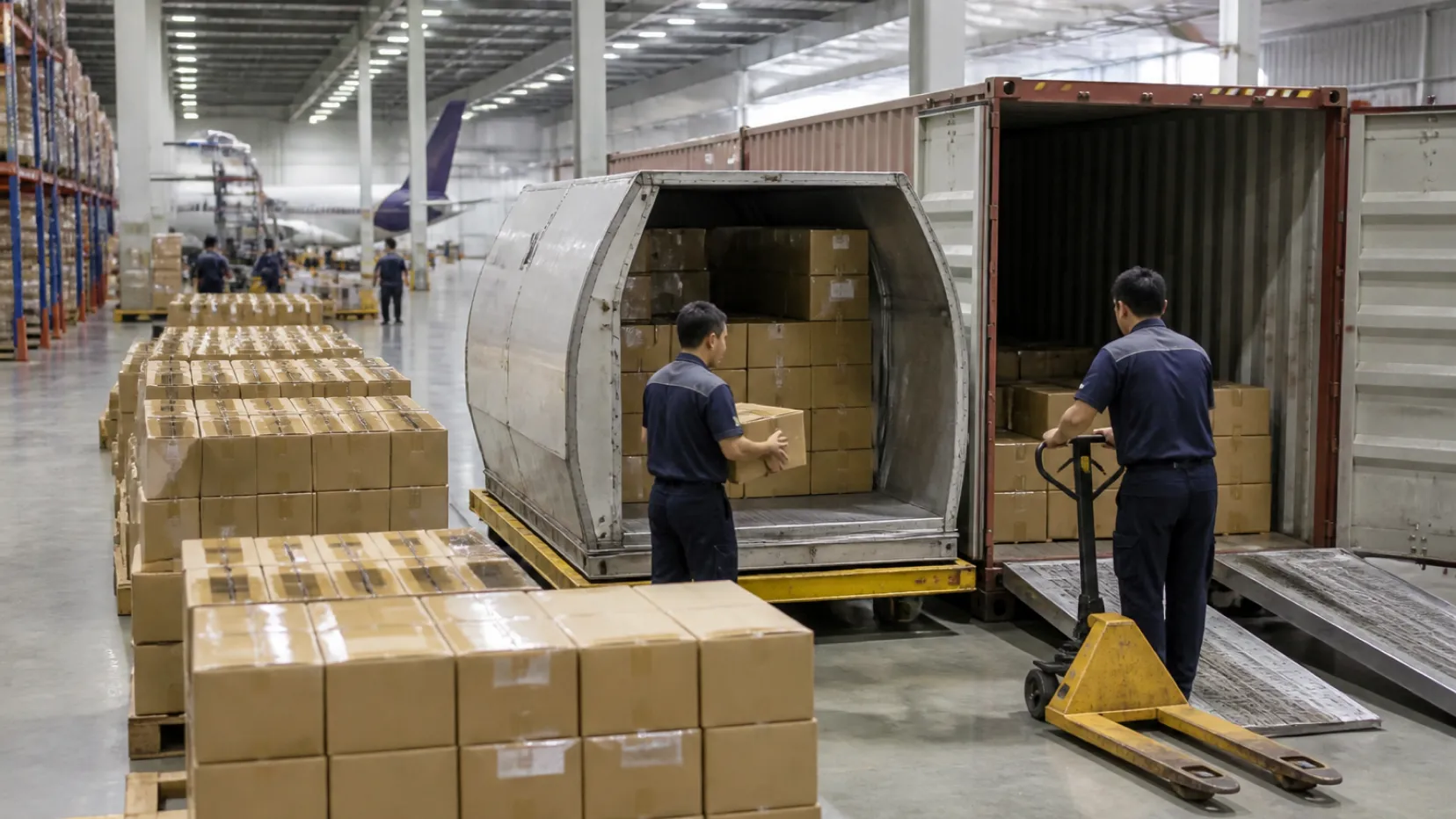
5. Retail Presentation and Packaging Logistics
The format of the product packaging directly dictates the freight strategy. Shipping silk garments packed in premium, rigid magnetic gift boxes via air freight is an economic impossibility due to the massive volume of empty air contained within the boxes. If a brand requires rigid gift boxes for the holiday season, the logistics must be decoupled.
The most efficient approach is to ship the silk garments flat-packed in minimal polybags via air freight, while the bulky, empty gift boxes are shipped via sea freight weeks in advance. The final assembly (placing the garment into the box) occurs at the domestic distribution center. For a comprehensive overview of how packaging affects both presentation and freight costs, review our packaging options guide.
6. Executing a Compliant and Timely Supply Chain
Successful holiday season procurement requires manufacturing partners who understand the rigid mechanics of global freight. Factories that miss ex-factory dates by even one week in September force their clients into catastrophic air freight upgrades to meet retail deadlines. At DreamSilk, we implement strict critical path management for all Q3 and Q4 production runs. Our logistics team coordinates directly with nominated freight forwarders to optimize carton dimensions, apply mandatory anti-moisture protocols for sea freight, and manage split-shipment documentation seamlessly. To secure your production capacity for the upcoming season and discuss optimized freight routing for your bulk orders, proceed to our contact portal for a direct consultation.
FAQ
Sea freight takes 35 to 50 days door-to-door and is highly cost-effective, making it ideal for large, planned bulk orders. Air freight takes 5 to 10 days but is significantly more expensive, especially for low-density items like silk garments, and is generally reserved for urgent replenishments or delayed production.